Probably not, unless you are reading this in China. While WeChat is available internationally, Weixin (as it is known in China) dominates the social media landscape in mainland China and is the envy of social media companies around the globe. So can anyone copy WeChat’s success?
Again the answer is probably not. But when David Marcus, the Facebook executive in charge of Messenger, calls WeChat “inspiring” and makes changes that emulate features of the Chinese super-app, you know the world is on notice. It remains to be seen how much influence WeChat will ultimately wield outside of China.
WeChat grew up and out of a unique set of circumstances.
China is a mobile-first country due to the declining cost of smartphones and the availability of the mobile network. SMS text-messaging was expensive and so users sought out free messaging apps. The culture of China also provided for a homegrown solution.
Tencent, the parent company of WeChat, has fostered a culture of innovation that put WeChat at the forefront of social media today. From the original design of the messaging app to the recent rollout of mini programs, the company is always looking for ways to offer new features that keep their users engaged and online.
More than a third of all the time spent by mainlanders on the mobile internet is spent on WeChat.
WeChat’s Red Envelope campaign is a well known example of innovation and engagement. Red envelopes are traditionally used to give money during weddings or holidays such as Chinese New Year. WeChat combined the traditional with the modern to create a marriage of commerce and culture.
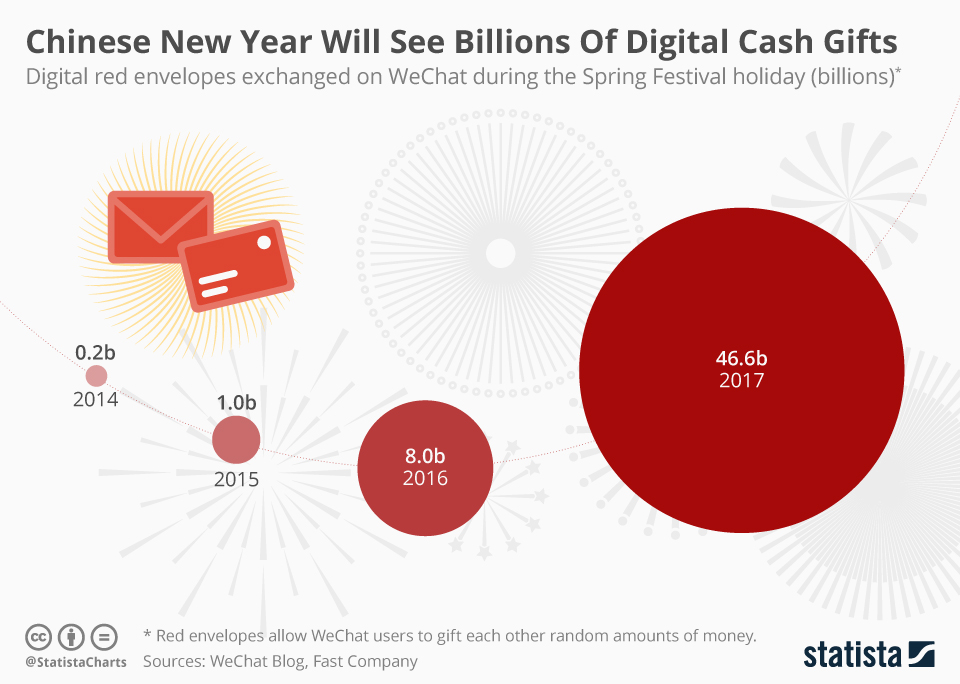
Traditionally, red envelopes are given from old to young, married to unmarried. WeChat allowed anyone to give to anyone. The campaign mixed traditional gift giving with gamification to make it exciting to its users. An individual could set-up a group of friends and family, select an amount of money and WeChat would randomly distribute the total among your group. This campaign generated 20 million envelopes upon its debut in 2014.
In 2017, 46.6 billion red envelopes were exchanged on WeChat — 33 envelopes for every person in China!
While wildly successful on its own, the Red Envelope campaign opened the door and users’ wallets to making payments with WeChat. To send red envelopes, a user was required to link their bank card to the app. This in turn led to paying for a taxi, food deliveries, travel, and online shopping.
Keys to WeChat’s success
Over 1 billion users
Over 50% have a linked bank card
Users return more than 10 times a day
Over 30% of time spent on internet is on WeChat
Over 50% of internet sales are mobile
Over 30% of WeChat users make regular e-commerce purchases through app
The Road Ahead
WeChat will continue to do what it does—innovate and dominate the Chinese market. Other Chinese competitors have tried to copy the success of the Red Envelope campaign. Facebook has copied elements of WeChat into Messenger and will continue to do so. Will WeChat be able to expand in a meaningful way beyond the Asian Pacific? Probably not. WeChat and all social media require an intimate knowledge of its audience in order to be as successful as WeChat.
WeChat knows its audience, has gained its trust and constantly delights them.
Is WeChat a model for an American super-app? Probably not. The US market followed a different development model with many players, many systems and many apps evolving over 20+ years. However, the market may be ready for a shift as fewer apps are being downloaded. Can a super-app, such as Messenger, emerge as the hub of all of your internet activity? Do you want an app that is there “at every point of your daily contact with the world, from morning until night?” Are Americans ready to put their trust in one super-app? Probably not.
Don’t just take my word for it, watch David Marcus of Facebook and SY Lau of Tencent discuss the road ahead and why WeChat can’t even drink a beer in America.
I remember my first blog post pair of glasses. Hated ‘em! And each time you needed new glasses, the same dread would return. Do any of these frames look good on me? Is it possible to tell hunched over, squinting between rows of glasses on a mirrored wall?
Help me!
While this isn’t a picture of my first pair of glasses, it’s obvious that I could have used some help. However, like all things fashion, I believe these are back in style. -4b1f-90ed-a37737b07816SELRES_3824d66f-53ea-4182-ab00-70e1cfd11b7cSELRES_3824d66f-53ea-4182-ab00-70e1cfd11b7cSELRES_e649d857-e5ca-4b1f-90ed-a37737b0
Charting a new course
Enter Warby Parker’s “Home Try-On Campaign.” Pick any 5 pairs of glasses and try them on at home without the pressure of making a decision in the store. That’s because there are no stores to visit (OK, they have some stores now but not at first.) and the glasses are less expensive, too. Sounds great but will it work?
The company made an important marketing decision to help customers with a potential hurdle. There is no charge to ship or return the trial sample of glasses. By removing this barrier, Warby Parker helped customers overcome one concern with trying their new and different service.
It works!
In less than eight years, Warby Parker has become a billion-dollar business that now includes retail locations, a new line of glasses for kids, and an online Prescription Check service. And, they have donated over 3 million pairs of glasses through their Buy a Pair, Give a Pair program. Yeah, I guess it worked.
But what really works for the company is the community that has emerged on social media.
Warby Parker’s community really seems to meet all the criteria required as defined by McMillan & Chavis:
membership,
shared emotional connection,
influence, and
needs fulfillment.
By choosing to go outside the normal channels for buying glasses, customers establish membership in the community. They are doing something unique. They are forming a common identity.
I believe that everyone who wears glasses shares an emotional connection. We can all relate to that feeling when you must get your first pair, the annoyance of trying to clean them, or looking through smudged or dirty glasses. We also appreciate being able to see clearly.
A key component of the dialogue on social media is posting a picture of your new glasses. User generated content shows happy people, with their new purchase, hopefully influencing their friends. It’s also been noted by Shandrow that there is a monetary effect to these posts – Warby Parker customers who post photos are twice as likely to buy.
Needs fulfillment is at the heart of the company, the origin.
“We believe that buying glasses should be easy and fun. It should leave you happy and good-looking, with money in your pocket.”
Just look at their social media platforms and you’ll see it play out in real-time.
I think it took me five visits this last time to finally choose some frames that I didn’t hate. I didn’t have any fun and didn’t leave with any money in my pocket. Next time, I’ll have to give Warby Parker a try. For now, I’m going to read a real blog.







 Jayspoke